A special edition newsletter with a few quick updates and featuring the many exhibitions around Canberra highlighting First Nations experience and culture – perfect for visiting over the summer break.
Update on our email problems
Firstly – apologies that you would have recently received the November newsletter for the second time! That was related to the problems with our emails and Mailchimp – hopefully all resolved now but, in working on that, the system generated an email with a newsletter already sent. So sorry for any confusion. At least the emails are working: if you need to get in touch, please email us on info@antaract.org.au. You can also connect with us via Facebook or Instagram.
David Hunter Memorial Lecture 2025
We have updated our pages on the David Hunter Memorial Lecture (DHML) held in October with the keynote talk from Blake Alan Cansdale: Readying Australia for truth: The transformative practice of truth-listening. We have also added slides from the presentation Prof Chris Cunneen and Dr James Beaufils provided when the Jumbunna report on the over-representation of First Nations People in the ACT criminal justice system was presented in September 2025. These are from extended version of the presentation they gave at the DHML.
Read more on the 2025 DHML page: https://antaract.org.au/dhml-2025-truth-telling/.
‘Truth through Transparency’: A Turning Point Report
The Aboriginal and Torres Strait Islander Elected Body (ATSIEB) have just released a report: ‘Truth through Transparency’: A Turning Point Report. This report is the outcome of the August 2025 Hearings of the Elected Body. For the first time, the Elected Body has undertaken their own full analysis of the ACT Government’s progress against the ACT Aboriginal and Torres Strait Islander Agreement 2019–2028.
As highlighted in the media release: “The findings are deeply concerning. Of the 22 targets in the Agreement, only 4 are on track. Four are not on track, 8 have worsened and 6 are not being measured at all. This shows that in many areas, outcomes are going backwards.“
Ready the full report at: https://atsieb.com.au/reports/report-from-hearings-12-14-august-2025-truth-through-transparency-a-turning-point-report/, and the media release at: https://atsieb.com.au/news/elected-body-calls-for-truth-through-transparency-in-the-2025-august-hearings-report/.
ANTaR ACT Organising Group
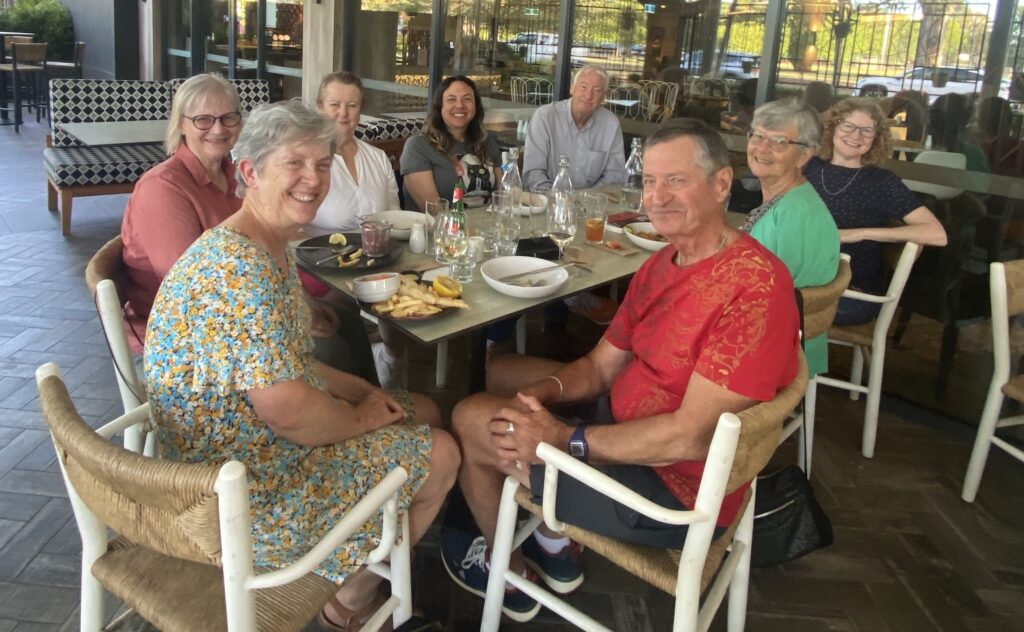
Best wishes for the season from all the ANTaR ACT organising group – here at our end of year dinner. We are planning on meeting in January, details to be determined. If you would like to join us as we plan for 2026, please get in touch: info@antaract.org.au.
Exhibitions
Super Kaylene Whiskey
To Monday 9 March 2026, National Portrait Gallery
Super Kaylene Whiskey celebrates one of Australia’s leading contemporary artists, proud Yankunytjatjara woman Kaylene Whiskey. This major survey brings together works from across Whiskey’s career, showcasing her dynamic practice that is grounded in stories of First Nations joy and strength. Drawn from public and private collections, the exhibition features paintings, video work and installations from her early career to now, as well as a newly commissioned portrait.
For more information, see: https://www.portrait.gov.au/exhibitions/kaylene-whiskey-2025.
Sun/Shadow: The Appearance of Pitjantjatjara ‘Hand Talk’: Tjuntjuntjara Community Artists, Louise Allerton
To 20 December 2025, photo access, Manuka Arts Centre, 30 Manuka Circle, Griffith
Aṉangu from Tjuntjuntjara Community (WA), have a rich cultural practice of gestural co-speech, a language using the hands, face and body. These gestures can be used to communicate across distance or in situations where speech is considered impolite or inappropriate. It is integral and embedded in everyday communications while being subtle and hidden, often going unnoticed by outsiders.
This body of collaborative photomedia experiments offers a glimpse into the vibrant and dynamic cultural practice of Marangka wangkapai (hand talk), drawing on years of creative and collaborative research between Allerton and Tjuntjuntjara artists, after decades of living and working together on Spinifex Country.
For more information, see: https://photoaccess.org.au/calendar/exhibitions/sun-shadow-creative-collaborations-on-pitjantjatjara-gestural-talk/
5th National Indigenous Art Triennial: After the Rain
To 26 April 2026, Level 1, Gallery 12, National Gallery of Australia
After the rain there are always new beginnings.
The 5th National Indigenous Art Triennial, After the Rain, features 10 large-scale, immersive and multi-disciplinary installations that celebrate inter-generational legacies and cultural warriors of the past, present and future.
The Triennial brings together commissioned work by established and emerging First Nations artists from across Australia, creating an important platform for art and ideas.
Each iteration of the Triennial is led by a First Nations curator with an original vision.
Artistic Director for the 5th National Indigenous Art Triennial is Tony Albert, Girramay/Yidinji/Kuku-Yalanji peoples, one of Australia’s foremost contemporary artists.
Albert weaves together projects by Alair Pambegan, Aretha Brown, Blaklash, Dylan Mooney, Hermannsburg Potters, Iltja Ntjarra Art Centre and Vincent Namatjira, Jimmy John Thaiday, Naminapu Maymuru-White, Thea Anamara Perkins, Yarrenyty Arltere Artists and Grace Kemarre Robinya, and Warraba Weatherall to tell stories through the universal language of visual art.
For more information, see: https://nga.gov.au/exhibitions/fifth-national-indigenous-art-triennial/
Kulata Tjuta: Tirkilpa
To 29 March 2026, Level 1, Gallery 15, National Gallery of Australia
Kulata Tjuta is an ongoing cultural maintenance project that shares the skills of carving and making the punu kulata (wooden spear) across generations. Kulata Tjuta: Tirkilpa is the largest and most significant installation of the culturally important and visually spectacular Kulata Tjuta (Many Spears) Project. Like others in the series, it is rooted in age-old traditions, knowledge and skills that are designed around keeping Country and culture strong. The artistic outcomes take the form of large-scale, multi-disciplinary installations which incorporate film, sound, live performance and other artistic collaborations.
For more information, see: https://nga.gov.au/exhibitions/kulata-tjuta-tirkilpa/.
Other First Nations exhibitions at the National Gallery
The National Gallery of Australia has an extensive collection from First Nations artists. In addition to the exhibitions mentioned above, other displays celebrating First Nations art and culture include:
Hermannsburg: The Hermannsburg School is an art movement pioneered by Western Arrarnta artist Albert Namatjira (1902–1959). This exhibition displays works by Namatjira, including painted spearthrowers, alongside watercolours by family members including sons Enos and Ewald Namatjira, son-in-law Benjamin Landara, and brother-in-law and ‘breakaway’ painter Otto Pareroultja. Ceramics by Judith Pungarta Inkamala, who grew up watching Namatjira paint, are displayed alongside pots by Carol Panangka Rontji, demonstrating the stylistic evolutions of the Hermannsburg School.
Featured works emphasise artists’ connections to Country and the diversity embedded within this landscape—from airy, tree-lined vistas to red, rocky escarpments and gorges.
Hot Tropics: Hot Tropics brings together works by First Nations artists who live in, or are connected to, the tropic and subtropical zones of Australia—an area encompassing Western Australia, the Northern Territory and Queensland, inclusive of Zenadth Kes/Torres Strait Islands.
Heavens Above: Heavens Above showcases the epic Seven Sisters creation story through a selection of works by First Nations artists from the national collection. Through sculpture and paintings on bark and canvas, artists from the Northern Territory and South Australia tell their different versions of a narrative that reveals how the Pleiades constellation and the star Orion were formed in Ancestral times.
Talking Blak: Talking Blak is an ode to First Nations women and non-binary people who fight against sexism and racism through their art. For these artists, sexism and racism exist as products of colonisation—to be continuously resisted.
Yuk Wuy Min Ngantamp – Aurukun’s artistic legacy: Yuk Wuy Min Ngantamp—Aurukun’s artistic legacy showcases the art and culture of First Nations artists from the Aurukun Community. Featuring major senior figures, as well as younger artists, the exhibition highlights intergenerational artistic expression and the transfer of cultural knowledge.
Our Story: Aboriginal–Chinese People in Australia
To 27 January 2026, National Museum of Australia
Our Story: Aboriginal–Chinese People in Australia sheds light on the little-known history of Aboriginal and Chinese relations in colonial Australia.
The exhibition explores themes of identity, survival, resilience and cultural connection, tracing these enduring legacies from the gold rush era to today.
For more information, see: https://www.nma.gov.au/exhibitions/our-story
Other First Nations exhibitions at the National Museum
The National Museum also has other exhibitions highlighting First Nations experience.
First Australians: Explore the shared stories and experiences of First Nations peoples from across the continent in First Australians.
Talking Blak to History: This exhibition in First Australians, on the lower ground floor, features powerful objects that speak to the aftermath of colonisation and explore issues including land rights, sovereignty, the Stolen Generations and deaths in custody.
ANTaR ACT acknowledges the traditional custodians of the land on which Canberra is situated, the Ngunnawal and Ngambri people. We acknowledge and respect their continuing culture and the contribution they make to the life of this city and this region. We also acknowledge other Aboriginal and Torres Strait Islander people who may visit this area.